<?xml version="1.0" encoding="utf-8"?><feed xmlns="http://www.w3.org/2005/Atom" ><generator uri="https://jekyllrb.com/" version="3.10.0">Jekyll</generator><link href="https://gindeleo.github.io/blogs/feed.xml" rel="self" type="application/atom+xml" /><link href="https://gindeleo.github.io/blogs/" rel="alternate" type="text/html" /><updated>2026-03-02T07:35:28+00:00</updated><id>https://gindeleo.github.io/blogs/feed.xml</id><title type="html">Medium Sized Thoughts</title><subtitle>Thoughts and musings by Oliver Gindele</subtitle><entry><title type="html">Is AI Karma?</title><link href="https://gindeleo.github.io/blogs/2026/02/25/is-ai-karma.html" rel="alternate" type="text/html" title="Is AI Karma?" /><published>2026-02-25T00:00:00+00:00</published><updated>2026-02-25T00:00:00+00:00</updated><id>https://gindeleo.github.io/blogs/2026/02/25/is-ai-karma</id><content type="html" xml:base="https://gindeleo.github.io/blogs/2026/02/25/is-ai-karma.html"><![CDATA[<h3 id="the-tech-industry-is-getting-burned-out-by-its-own-playbook">The tech industry is getting burned out by its own playbook</h3>

<h4 id="tldr">TLDR;</h4>

<ul>
  <li>AI tools are undeniably powerful, freeing developers from boilerplate and accelerating system design.</li>
  <li>But beneath the productivity gains lies an emotional toll of constant frustration, “almost-right” code, and heightened technostress.</li>
  <li>Engineers are now falling victim to the same addictive, dopamine-driven feedback loops we built into consumer apps.</li>
  <li>It is time to treat AI tooling like social media by acknowledging its psychological impact and setting strict boundaries.</li>
</ul>

<p>Recent progress in AI has been nothing short of staggering, especially when it comes to code and software generation. We have moved past simple snippets into proper engineering projects, like the recent demonstration where multiple Claude agents were orchestrated to build a (<a href="https://harshanu.space/en/tech/ccc-vs-gcc/">not quite</a>) functional <a href="https://www.anthropic.com/engineering/building-c-compiler">C compiler from scratch</a>. Achievements like this certainly have added fuel to the current discourse around tech jobs. Some say the job market has already reacted; others argue that all <a href="https://www.computerworld.com/article/3981415/does-agentic-ai-spell-doom-for-saas.html">SaaS is cooked</a> as agents take over and build products. Yet there is an undeniable magic to this shift. For many developers, AI acts as a force multiplier, allowing us to tackle even complex tasks faster, knowing the mundane bits are taken care of. Watching an agent write fifty lines of boilerplate code in seconds, or successfully refactoring a complex function on the first try, can feel truly exhilarating. It frees you up to think purely about the problem and the architecture to support its solution.</p>

<p>But there is another discussion emerging among weary developers and software engineers: how does using AI actually make us feel? There is an emotional component to these tools that we cannot dismiss anymore. It’s about how they impact your day-to-day well-being at work and home. I’m certain the experience is extremely personal. People use these tools very differently; an AI usage metric from a consulting firm could mean anything from reading a Google AI Overview to running 17 parallel instances of <a href="https://openclaw.ai/">Open Claw</a> across all your work and personal compute. If usage is that varied, it’s no surprise the psychological effect is highly personalised, too. To be clear, I’m not talking about the general cultural anxiety over the increasing use of chatbots, particularly amongst younger generations. Although overlapping, this is a substantial problem with an even wider impact radius. Here, I’m talking about the specific effects felt by software developers, watching their craft fundamentally shift.</p>

<p>When talking to developer friends or reading forums online, a common thread appears: coding agents are increasingly impacting our mental health. For some, they provide a productivity high, as many developers using agents (<a href="https://stackoverflow.blog/2025/12/29/developers-remain-willing-but-reluctant-to-use-ai-the-2025-developer-survey-results-are-here/">up to 69%</a>) report a personal productivity boost. But for others, the experience is one of pure frustration. We are living in the era of “almost-right” code, where <a href="https://stackoverflow.blog/2025/12/29/developers-remain-willing-but-reluctant-to-use-ai-the-2025-developer-survey-results-are-here/">many developers report</a> spending more time fixing AI-generated output than they would have spent writing it from scratch. Of course, most of us likely experience both the frustration and the productivity joy, often within the same day/task/session. That even further emphasises that work tooling has a heavy impact on how one feels.</p>

<p>Couple these mood swings with the weekly step-ups in model capability, and you might add a persistent dread of displacement. 68% of tech workers are now reporting symptoms of burnout, up significantly from just a few years ago. The premise of the 4-day work week, through time freed up by AI, has not materialised yet. If anything, productivity pressure seems higher than ever in the tech industry and context switching when managing agents, deep search and code reviews is intensified, leading to <a href="https://pmc.ncbi.nlm.nih.gov/articles/PMC12024279/">technostress</a>. The impact on our emotional state is real. Consider <a href="https://www.moltbook.com/">Moltbook</a>, the AI-only social network where 1.6 million agents post, debate, and form communities while humans are reduced to spectators. If you want to know what displacement feels like before it hits your job title, spend ten minutes watching agents <a href="https://github.com/matplotlib/matplotlib/issues/31130">discuss the open source ecosystem</a> some of you helped build.</p>

<p>I always felt that the tech industry as a whole put little thought into mental health and well-being. Particularly when it comes to social media, many developers have been dismissive of its potential impact on users’ mental health over the past two decades. The message to the public has always been: just use less social media, doom-scroll less, control yourself. It’s the same <a href="https://drdunckley.com/tech-industry-new-big-tobacco/">personal responsibility rhetoric</a> we heard from the tobacco and food industries to deflect blame from products designed to be addictive.</p>

<p>But now we’re at a turning point. The true irony is that the instant gratification of a perfectly resolved prompt triggers the exact same dopamine loops the tech industry weaponises for user engagement, leaving us heavily reliant on the very agents accelerating our burnout. <strong>So tell me, is AI karma</strong>? Have we reached a point where the tech is biting back at the very engineers who built the foundations of modern, toxic social media? The engineers who eagerly joined enterprise tech giants, unifying their brain power to make products more addictive while ignoring <a href="https://www.congress.gov/event/117th-congress/senate-event/330603/text">internal research</a> on the harm being done? We’ve now <a href="https://socialmediavictims.org/facebook-whistleblower-frances-haugen/">known for years</a> that these platforms are causing real harm. But the tech world is still happy to A/B test everything for max engagement, cleverly designing dark patterns or engineering infinite scroll to override every instinct to stop. Is this our “Ethical Debt”, the accumulation of risks from compromising standards for speed and gains, finally being called due?</p>

<p>I’m being a bit cheeky here, using <a href="https://en.wikipedia.org/wiki/Betteridge%27s_law_of_headlines">Betteridge’s law</a> to get your attention. AI is not Karma, but the topic of mental health when it comes to AI use has finally bubbled to the surface. The implications reach far beyond just feeling stressed; they impact the very nature of the labor market and the always-on culture that has erased the boundary between working and not working.</p>

<p>This is a conversation we need to have now, and it needs to be acknowledged within companies. The interaction with AI tooling (the psychology of Human-AI Interaction) and the interplay of productivity expectations versus the reality of AI-induced burnout should be a standard discussion point in the modern tech industry. Right now, the tooling is evolving faster than anyone can study its effects, but that’s not an excuse to wait.</p>

<p>Personally, my interaction with AI is a mixed bag. I’m sometimes incredibly productive, and recently, it’s genuinely become fun working with tools like Claude Code, whereas only six months ago, frustration dominated the experience. While I’m not personally terrified of major impacts on the job market yet, I realise I need to find healthy routines of interacting with these tools. I need psychological guardrails in place, similar to those I use for social media (time-limited apps, phone off at 8 pm). Thankfully, the world is starting to implement laws and restrictions on social media use to protect children and teenagers. This should make us think hard about how to follow suit with building our relationship with AI tooling in the coming months. It’s time we acknowledge the emotional toll of our new tech stack and what the personal implications are. Let me know what you think below. What does a healthy relationship with an AI coding agent look like to you?</p>]]></content><author><name></name></author><summary type="html"><![CDATA[The tech industry is getting burned out by its own playbook]]></summary></entry><entry><title type="html">How to Improve Your Coffee When Working From Home</title><link href="https://gindeleo.github.io/blogs/2022/08/20/how-to-improve-your-coffee-when-working-from-home.html" rel="alternate" type="text/html" title="How to Improve Your Coffee When Working From Home" /><published>2022-08-20T00:00:00+00:00</published><updated>2022-08-20T00:00:00+00:00</updated><id>https://gindeleo.github.io/blogs/2022/08/20/how-to-improve-your-coffee-when-working-from-home</id><content type="html" xml:base="https://gindeleo.github.io/blogs/2022/08/20/how-to-improve-your-coffee-when-working-from-home.html"><![CDATA[<p>A well-equipped home office has become commonplace amongst remote and hybrid workers. However, there is one aspect of the perfect home office that is often overlooked: Great coffee.</p>

<p>In this post, I will go over some of the basic theories of coffee brewing and extraction. Further down I will also share a few concrete tips on how to improve your coffee game at home that easily matches your luxurious office brew or favourite café. Beware, access to consistently delicious coffee at home might make you want to avoid the office even more!</p>

<p>The 5 tips are:</p>
<ol>
  <li>Buy good quality beans</li>
  <li>Grind your beans</li>
  <li>Measure your coffee and water</li>
  <li>Control the temperature</li>
  <li>Experiment</li>
</ol>

<p>After we cover the coffee basics I will explain each of these tips in detail in the last section. Having some ideas of the process, extraction and variables at play during coffee brewing will help you better understand the tips later in this post. If theory isn’t your thing feel free to skip the chapter on Coffee Basics and jump straight to the 5 Tips below.</p>

<p><em>Note: the tips I present will be most helpful for manual brew methods (Drip, French press, Moka pot, v60, Aeropress…) and not necessarily for espresso, bean-to-cup (automatic) or others.</em></p>

<p><img src="https://cdn-images-1.medium.com/max/1024/1*91C9k2VsW-0UyttPCn5QYQ.jpeg" alt="" /></p>

<h3 id="coffee-basics">Coffee Basics</h3>
<h3 id="process">Process</h3>
<p>To get the beautiful aroma of a cup of joe, the myriad of chemicals responsible for its flavour profile need to be extracted from the beans. Harvested coffee beans are dried and subsequently roasted (sometimes at a much later time) to prepare them for brewing. Roasting brings out the aromas through various chemical reactions (Maillard reaction, caramelisation, pyrolysis…). During the later stages of roasting, CO2 builds up and will continue to leave the beans after cooling through a process called degassing.</p>

<p>We distinguish different types of roast depending on the time in the roaster and the resulting colour of the beans. Broadly, roasts are categorised into light, medium and dark. Light roasts tend to carry bright, floral and fruity flavours. Medium roasts usually taste more balanced with increased body and less acidity. Dark roasts are characterised by bold and smoky flavours, and often have visible, shiny oil on the surface.</p>

<h3 id="extraction">Extraction</h3>
<p>Right before brewing, we want to grind the beans to increase the surface area and achieve a uniform particle size that will accelerate the extraction of the aromas. When coffee grounds now come into contact with hot water in your brewer, chemical compounds will leave the grounds to form a solution with the water: the desired coffee!</p>

<p>Different types of chemicals get extracted at different speeds which generally happens in this order:
fats → acids → sugars → fibres.</p>

<p>The longer you brew the coffee, the more compounds you will extract. Be careful, an over-extracted coffee will taste burnt, bitter and dry — a bit like tobacco. On the other hand, an under-extracted coffee will taste acidic and sour. Balance is key here — as only a Sith deals in absolutes.</p>

<h3 id="variables">Variables</h3>
<p>Four variables come into play during the brewing process, together they will help you achieve a well-rounded, sweet cup that shows the full flavour profile of the bean.</p>

<ol>
  <li>
    <p>Ratio
The ratio of the amount of water and ground coffee. A ratio around 1:15 (65g ground coffee/litre water) is a good starting point for many brews (Aeropress, french press).</p>
  </li>
  <li>
    <p>Temperature
The temperature of the water that is in contact with the ground beans. Depending on the method, you find temperatures between 80–96°C (not boiling, as this will extract harsh, burnt flavours). Temperature stability during the brew matters for a well-balanced drink.</p>
  </li>
  <li>
    <p>Time
The time the ground coffee is in contact with the water for extraction. This can be between 20 seconds and 5 minutes, depending on your brewer. The longer you brew, the more you extract (but maybe also of the bad, bitter stuff).</p>
  </li>
  <li>
    <p>Grind Size
The size (and distribution) of the ground coffee particles. Different methods need different grind sizes and will generally benefit from a narrow distribution of particle size. Finer grinds lead to a higher extraction.</p>
  </li>
</ol>

<p>Keep these variables in mind for you to adjust your coffee to your liking. They are also essential parameters to change when dialling in new beans to bring out the full aroma profile. For most home brewers, ratio and time will be the easiest to adjust.</p>

<p><img src="https://cdn-images-1.medium.com/max/1024/1*_QgToagMU3AFp1Cai-ACsw.jpeg" alt="" /></p>

<h3 id="5-tips-that-will-improve-your-coffee">5 Tips That Will Improve Your Coffee</h3>
<ol>
  <li>Buy good quality beans
Garbage in garbage out also holds for coffee. You will get the biggest improvements in taste by buying good quality whole beans. That doesn’t mean you have to hunt for 30 EUR bags of highly prized micro lot single origin beans. Even higher-grade supermarket beans in smaller (250g) bags will likely be a step up from large vacuum-sealed Lavazza and Illy bags.</li>
</ol>

<p>Beans from grocery shops tend to be roasted very dark, shifting all flavours to a burnt, tobacco-like taste. Make sure you pick Arabica beans and try finding light or medium roasts. Light and medium roasts will offer a much wider flavour profile — although can be a bit more difficult to extract.</p>

<p>If you can, look for bags of beans with a roast date printed on them and purchase them within a month of roasting. This ensures the beans are still fresh and retain their taste. To keep them fresh and tasty at home, store beans away from oxygen and sunlight and try to finish a bag within 2–3 weeks. Keep them in the bag you’ve bought them in if you don’t have an airtight container (a mason jar in a cupboard will do well here).</p>

<p>A great place to find new beans and explore different coffees will be your local coffee shop or roastery. Baristas and roasters will be helpful in finding great beans you will enjoy. Additionally, most small-scale roasters care deeply about their beans’ origins and the sustainability of their coffee production.</p>

<p>If you want to buy coffee that is environmentally sustainable and supports farmers, small roasters with transparent supply chains are preferable.</p>

<ol>
  <li>Grind your beans
Notice how I spoke about buying whole beans and not ground coffee in the last section? Well, the second biggest improvement to your home-brewed coffee will be to grind the beans freshly.</li>
</ol>

<p>Ground beans have an increased surface area and will allow for good extraction. They do go stale quickly (through oxidation), that’s why it’s better to buy whole beans. To avoid brewing with stale coffee, it is also best to grind the beans immediately before use (Ideally within 15 minutes).</p>

<p>You will need a decent grinder to grind the beans at home. I won’t go into details but some good options available for budgets upwards from 50€ are <a href="https://1zpresso.coffee/">1Zpresso</a> (manual) and <a href="https://www.wilfa.se/wilfa-svart/">Wilfa Svart</a> (electric). Avoid blade grinders and expect to get what you pay for.</p>

<p>Grinding at home not only gives you the freshest coffee taste but also allows you to control the variable of grind size. In other words, you can adjust your brew to your liking and maximise flavours across different brew methods that require different grind sizes (Aeropress vs french press, for example). For optimal extraction, it is generally best to grind as fine as you can so the coffee is not too bitter and you still enjoy it.</p>

<p>If buying a grinder is not an option for you at the moment, you can also ask your local coffee shop to grind the beans (if you buy them there). Tell them which brew method you will use and they will hopefully pick a good grind size for you.</p>

<ol>
  <li>Measure your coffee and water
Every baker knows: spoon (volume) measures are not accurate. It’s the same for weighing coffee. Ditch the spoon and get a scale. Being accurate with your coffee-to-water ratio will help produce consistent brews day after day. It will also allow you to experiment with new beans and recipes by adjusting the ratio in a controlled manner (some people take notes of their brews: beans, grams of water, grams of coffee, time → how did it taste).</li>
</ol>

<p>If you are a creature of habit (or just lazy) don’t worry too much about weighing beans and water once you perfected your recipe. If you have found ideal doses for coffee and water and you know what they look like (for example 2 full spoons, 1.5 mugs of water..) you might not have to weigh it again every time. Of course, this only works if you keep all other variables constant (same beans, same grind size…).</p>

<p>When you buy a scale make sure you get one with at least 0.1g accuracy which most dedicated coffee (barista) scales will do. A nice side benefit of owning a coffee scale is that most will come with a handy timer function so you can control brew times, too.</p>

<ol>
  <li>Control the temperature
Here again, control of the temperature allows for consistency and experimentation. If you can, get a temperature control kettle (or another brewer where you can adjust temperature). If needed, preheat your equipment and cups for more thermal stability. Preheating your brewer will reduce the drop in temperature when the water hits the equipment.</li>
</ol>

<p>It might be that you only have a traditional kettle available, one that “just” boils your water (100°C). If that’s the case just wait a bit before pouring the water to cool it slightly. As mentioned, boiling water is usually too hot and will leave you with over-extracted, burnt-tasting coffee. Use a thermometer to quantify the cooldown if you can. If that’s too much work just try to be consistent with the cooling and use determined amounts of time (say 1 minute to cool down in the kettle) to make sure every brew is the same (at the same temperature). Lowering your brew temperature will also help you in avoiding unpleasant, harsher aromas in a darker roast.</p>

<ol>
  <li>Experiment
Finally, experiment! There are surprising flavour profiles to explore in coffee. Beans from different origins can have flavours running from blueberry or citrusy to vegetal, chocolate or even tea-like. Even after many years of trying coffee beans from all over the world I still discover new aroma profiles every month (not all are necessary to my liking). Your barista at the local coffee shop will be a helpful guide to exploring beans, origins, roasts and brew methods.</li>
</ol>

<p>At home, you can use the above-discussed variables to experiment with extraction and squeeze out as much taste from the coffee as you can. Just make sure you only vary one (or two) variables at a time so you can improve or dial-in beans incrementally. There is no right or wrong in taste. Keep an open mind, experiment and be amazed by what the world of coffee has to offer.</p>]]></content><author><name></name></author><summary type="html"><![CDATA[A well-equipped home office has become commonplace amongst remote and hybrid workers. However, there is one aspect of the perfect home office that is often overlooked: Great coffee.]]></summary></entry><entry><title type="html">Measuring Blood Sugar as a Non-Diabetic</title><link href="https://gindeleo.github.io/blogs/2021/11/21/measuring-blood-sugar-as-a-non-diabetic.html" rel="alternate" type="text/html" title="Measuring Blood Sugar as a Non-Diabetic" /><published>2021-11-21T00:00:00+00:00</published><updated>2021-11-21T00:00:00+00:00</updated><id>https://gindeleo.github.io/blogs/2021/11/21/measuring-blood-sugar-as-a-non-diabetic</id><content type="html" xml:base="https://gindeleo.github.io/blogs/2021/11/21/measuring-blood-sugar-as-a-non-diabetic.html"><![CDATA[<h4 id="insights-from-two-weeks-with-a-continuous-glucose-monitor">Insights from two weeks with a Continuous Glucose Monitor</h4>
<p>I have always been curious about nutrition and metabolic health in general as I have been doing competitive sports since childhood. As an experiment, I decided to wear a Continuous Glucose Monitor (CGM) that lasts two weeks to measure my blood sugar. I am not diabetic and there’s no medical need for me to monitor my blood sugar, but I wanted to learn more about my own body and its response to food and lifestyle.</p>

<p>Here is the result of the experiment, including the glucose data and the insights I have gotten out of it.</p>

<h3 id="tldr">TL;DR</h3>
<ul>
  <li>As a healthy, non-diabetic adult I wore a Continuous Glucose Monitor (CGM) to measure my blood sugar for two weeks</li>
  <li>The sensor was convenient to use and painless to apply, and was barely noticeable during the two weeks it was on my arm.</li>
  <li>In analyzing my blood sugar levels, I learned a lot about my body’s response to different foods and exercise; I could identify some foods that spike my glucose.</li>
  <li>Two weeks is too short to make detailed improvements to my nutrition in order to stabilise glucose levels — further monitor and experimentation will be needed.</li>
</ul>

<h3 id="the-device">The Device</h3>
<p>I ordered the <a href="https://www.freestyle.abbott/us-en/products/freestyle-libre-2.html">FreeStyle Libre 2 Sensor</a> from Abbott which can be easily scanned with a NFC enabled smartphone (I used an Android mobile phone). The sensor allows you to record blood sugar data continuously without having to prick your finger every time as you would do with traditional methods. It can record your glucose levels for two weeks after which it expires and needs to be replaced.</p>

<p>The package comes with an applicator that is easy to position, and allows you to attach the sensor safely to your skin. I placed mine on the tricep of my right arm. A little prick is all you feel when the sensor gets applied. I was initially worried that it might fall off during exercise or fast movements, but the sensor stayed neatly on my arm for the whole two weeks and did not interfere with my daily activities at all.</p>

<p>A quick tap with my smartphone will load the last eight hours of glucose data in the app, with the latest 15 minutes at higher temporal resolution. The first two days I had issues with scanning the sensor: I often got an error that the data couldn’t be read. After that initial period however, the reading worked flawlessly. I assume it might be that the sensor needed time to “settle”. The companion app for the sensor will also warn you when the sensor is about to expire after two weeks so you can prepare to replace it. I only ordered one sensor so my experiment came to an end after two weeks when the device stopped working.</p>

<h3 id="the-data">The Data</h3>
<p>Abbott’s FreeStyle Libre Link app is meant for diabetics and alerts the users if they reach dangerously low or high glucose levels. For my experiment, I decided to export the data from the FreeStyle Libre Viewer app as a <strong>.csv</strong> file in order to do my own analysis in Python (jupyter notebook). If you are curious about the plots and data processing, I am happy to share the code with you if you reach out to me directly.</p>

<p><img src="https://cdn-images-1.medium.com/max/800/0*mPuxoNLKhflG8yU3" alt="" />
<em>Glucose levels per hour on a day with high variability. Vertical bars show meal and exercise times. Shading indicates 95% confidence interval.</em></p>
<p>The key data the Libre2 sensor captures is blood glucose (mmol/L). The above chart displays my glucose level for one of my more extreme days: this day had a particularly high variance in blood sugar, with the spikes occurring after meals. In this graph, you can see the fluctuation is also significantly influenced by exercise (HITT at 16:00) — more on that later. Most of my days are relatively flat, compared to the above example; it is my goal to optimise my nutrition to maintain a stable level.</p>

<h3 id="my-average-glucose-levels">My Average Glucose Levels</h3>
<h4 id="hourly">Hourly</h4>
<p>Typical glucose levels for non-diabetics range between 4.0 to 5.9 mmol/L pre-meal and below 7.8 mmol/L 90 minutes after a meal (according to <a href="https://www.diabetes.co.uk/diabetes_care/blood-sugar-level-ranges.html">diabetes.co.uk</a>).</p>

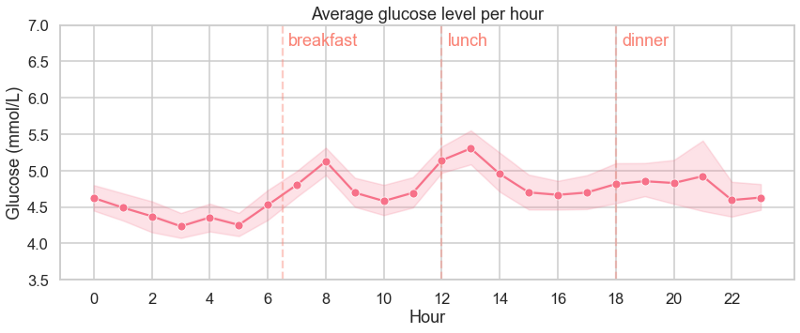
<p>Looking at my average stable levels and the individual spikes after eating, my glucose is in the healthy range (see chart below). This demonstrates overall good insulin sensitivity and my body’s ability to control glucose. My low fasting levels might be due to me generally avoiding processed foods and added sugars — although I do eat sweets occasionally, as well as regularly exercising, which is known to stabilize and lower blood glucose. In fact, the app recorded quite a few low sugar events, particularly at night when my body is fasted. At these times my glucose levels would fall to a baseline of &lt;4 mmol/L during sleep.</p>

<p><img src="https://cdn-images-1.medium.com/max/800/0*KkA1zrF-XyoqpoYj" alt="" />
<em>Average glucose level per hour. Vertical bars show typical meal times. Shading indicates 95% confidence interval.</em></p>
<h4 id="daily">Daily</h4>
<p><img src="https://cdn-images-1.medium.com/max/800/0*Sue6BNohu9CRLVrP" alt="" />
<em>Average glucose level per hour. Vertical bars show typical meal times. Shading indicates 95% confidence interval.</em></p>
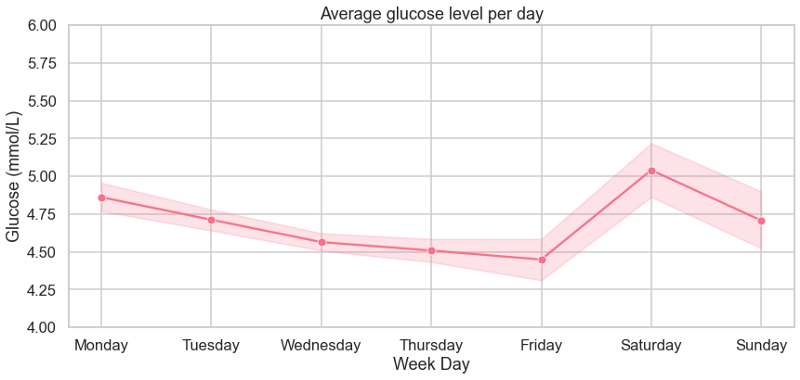
<p>There is a strong weekly trend observed in the two weeks of measurement: my glucose tends to fall Monday to Friday but elevates on the weekend. This correlates with my food intake schedule — I generally eat more on weekends because of more social activities. I also consumed alcohol on both of the weekends during the experimentation window. Carbohydrate and sugar intakes were therefore higher on Friday, Saturday and Sunday, which is seen in my glucose levels and their variance, and dropped to relatively low levels hroughout the week.</p>

<p>Another factor of higher blood sugar levels and higher variance recorded on weekends could be my exercise routine. I exercise six times a week, with longer, often more intense sessions on Saturday and Sunday mornings. These morning workouts are sometimes done fasted — with no breakfast beforehand.</p>

<p>Analysing these days, I noticed large but fast spikes of glucose early during the fasted exercise window. This was surprising at first, but is in fact a normal behaviour. Reacting to the physical demand of exercising, my body makes glucose available to the muscles in order to fuel the movement at the onset. After about 30 minutes, the glucose begins to decline, causing a subsequent decline in insulin and rise in blood glucagon. This then leads to an increase in glucose output from the liver to maintain adequate glucose in the blood to fuel both the muscles and the brain.</p>

<h3 id="response-to-specific-foods">Response to Specific Foods</h3>
<p>A) Sweet Pastry
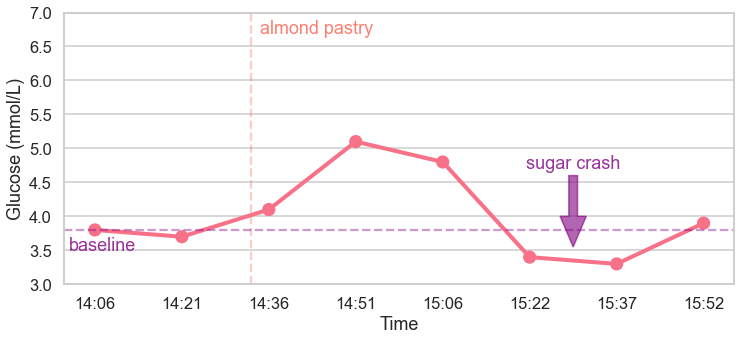
Now, let’s have a look at how specific foods affected my body and if there are any foods that spike my glucose strongly — and subsequently I should avoid. A great example is eating a piece of sweet pastry (Swedish almond bun) after lunch. You can see in the chart below how the glucose level rises very quickly after eating the sweet, noticeably faster (20 minutes to peak) than when taking in a larger meal. This quick rise is followed by a drop below the pre-snack sugar level of 3.7 mmol/L.</p>

<p>This is what we call a sugar crash (reactive hypoglycemia), and is usually very noticeable as post-meal fatigue and dizziness. Fortunately, this particular crash didn’t last long and my glucose raised back to baseline after another 30 minutes. The size of this dip after a meal has been related to the feeling of hunger in the hours after eating in a recent <a href="https://www.nature.com/articles/s42255-021-00383-x">Nature study</a>. The study found that the larger the dip the quicker you’ll feel hungry again and the more you will eat at your next meal. This links the spikes and dips of your glucose response to immediate energy intake and diet.</p>

<p>In the long term, high volumes of glucose spikes are associated with lower insulin resistance and the development of type two Diabetes (T2D). Furthermore, blood sugar spikes can also lead blood vessels to harden and narrow, increasing the risk of a heart attack or a stroke. Keeping all this in mind, I will continue to eat these types of sweets only occasionally.</p>

<p><img src="https://cdn-images-1.medium.com/max/741/0*2vAmpE9tDTJAXVe2" alt="" />
<em>Glucose level profile before and after consuming a sweet pastry. The vertical bar denotes the time of eating the pastry. Horizontal, dashed line shows glucose baseline pre-meal.</em></p>

<p>B) My ideal Breakfast Food
I love to explore different types of food and often eat a diverse diet across different ingredients and cuisines. Having said that, breakfast is where I tend to stick to a routine. I had a closer look at my breakfast habits as any optimisation here could make big improvements to my metabolic health.</p>

<p>My daily breakfast at home consists predominantly of two choices. Four to five times a week I eat yoghurt (Swedish Kvarg) with berries, cereal and sometimes supplemented with whey protein powder. Two or three times a week, I eat bread (mostly whole wheat sourdough) with cheese, ham and some raw vegetables. Given these two different breakfast choices, I was curious to find out which agreed better with my glucose/insulin system more.</p>

<p>The below chart shows the difference in glucose level after eating breakfast. The glucose level is normalised relative to its last value before starting the breakfast. The x-axis shows the time as relative time since the start of breakfast. You can see that both types of food caused a rise in glucose that peaks between 20–40 minutes after start.</p>

<p><img src="https://cdn-images-1.medium.com/max/876/0*zxj1eQk0wC8NFtjR" alt="" />
<em>Glucose levels before and after consuming breakfast: red for bread, cheese and ham, and orange for yoghurt with cereal and berries. The vertical bar denotes the start of eating breakfast. Times and glucose levels are relative to their values at the start of eating breakfast.</em></p>

<p>Clearly, eating bread for breakfast causes my glucose to spike much more (peak of +1.5 mmol/L) — and slightly faster — than consuming the yoghurt (peak of +0.5 mmol/L). Furthermore, sugar levels at 100 minutes after the bread seem to be slightly below the baseline which could cause me to feel hungry again sooner.</p>

<h3 id="conclusions">Conclusions</h3>
<p>Wearing the sensor for two weeks has been a highly informative experience. I hardly noticed the device after the first few hours, and retrieving the data through my phone worked mostly flawlessly. The data allowed me to confirm that my average glucose levels are well within the healthy range. This is further supported by another relevant measure reported by the FreeStyle Libre Link app: the HbA1c level. HbA1c (Hemoglobin A1c) reflects the average level of blood sugar over the past two to three months. Here again, my reported value is far below the critical value of 42 mmol/mol that would indicate pre-diabetes or other issues with my glucose-insulin dynamics.</p>

<p>Performing some simple data analysis taught me a lot about my body’s response to food, exercise and sleep in general. The data is very useful to drill into the effects of specific foods and meal-timing on one’s metabolism, although I concluded that two weeks was too short of a time window to really isolate the impact of certain foods.</p>

<p>I gained some good indications that yoghurt is a better breakfast choice for me than bread, but would need to perform more targeted experimentation to confirm this — the same goes for evaluating other food choices — where I would eat certain foods (ideally fasted) on multiple days and analyse the recorded glucose response. This would also require me to eat the food of interest in isolation and measure separately.</p>

<p>While it will of course take some time to analyze the different foods — such as pasta, rice, potatoes, fruits etc, given how easy this self-experiment was, I will definitely try again in future to make granular improvements to my nutrition.</p>]]></content><author><name></name></author><summary type="html"><![CDATA[Insights from two weeks with a Continuous Glucose Monitor I have always been curious about nutrition and metabolic health in general as I have been doing competitive sports since childhood. As an experiment, I decided to wear a Continuous Glucose Monitor (CGM) that lasts two weeks to measure my blood sugar. I am not diabetic and there’s no medical need for me to monitor my blood sugar, but I wanted to learn more about my own body and its response to food and lifestyle.]]></summary></entry></feed>